Grassroots Organizing in Haiti
The People’s Organization for the Development of Haiti
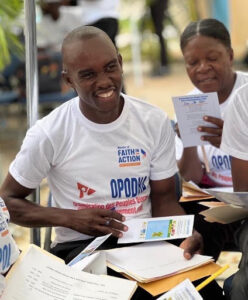
The People’s Organization for the Development of Haiti (OPODHA) is a Haitian civic movement with chapters in Haiti’s Northeast and North Departments, 76 community organizations, and more than 5,500 active grassroots members.
OPODHA members meet bi-weekly in their communities to listen to their neighbors, set community priorities, negotiate with local officials, take collective action to solve local problems, pool their resources in mutual solidarity loan funds, and organize agricultural and commercial cooperatives. They elect officers who meet annually each August.
OPODHA is not a service provider or implementer of international development projects. It functions as a broad-based civic movement dedicated to developing the leadership and organizing skills of local residents, building unity among communities across the Northeast and North, and advancing a shared agenda for sustainable development and democracy in Haiti.
Mutual Solidarity Loan Funds
OPODHA has organized 54 mutual solidarity loan funds with 3,132 enrolled members and financial capital of 31,234,501 Haitian gourde (equivalent in purchasing power to approximately $9.6 million in the United States). Members borrow funds at 2% interest to pay for school fees, start micro-businesses, and purchase products wholesale to be sold at markets.
We Plant Today So We Can Feed Ourselves Tomorrow
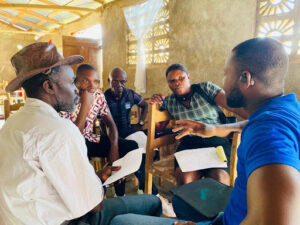 OPODHA is campaigning to increase investment in agriculture so that smallholder farmers can increase their productivity and help fight high levels of hunger in Haiti.
In 2025, 2,683 farmers (61% women, 39% men, 12% youth) in 27 communities worked with OPODHA to farm collectively. OPODHA used the final $50,000 in funding from a terminated Inter-American Foundation grant to purchase irrigation systems for 22 communities and partnered with the St. Barnabas Agricultural Center to install the systems and train farmers to use them.
In 2024, OPODHA and St. Barnabas created a pilot Northeast Community Seed Bank, which provided high quality seeds to farmers in 7 communities.
In 2023, OPODHA trained 100 grassroots leaders to survey more than 4,000 smallholder farmers; in November-December 2025, OPODHA resurveyed 1,100 farmers in 74 communities to provide input into agricultural policy in Haiti.
Smallholder Farmer Platform for North and Northeast Haiti
In 2026, OPODHA worked with St. Barnabas Agriculture Center (CASB), Partnership for Local Development (PDL), the Organization for the Development of Emancipated Woman (ODFEH), Lambi Fund of Haiti, and other Haiti organizations to develop a 13-point platform for promoting sustainable agricultural development in North and Northeast Haiti.
That platform has been the basis for a campaign to press the Inter-American Development Bank (IDB), the International Fund for Agricultural Development (IFAD), and the Haitian Ministry of Agriculture (MARDNR) to make changes to the design of a $44.2 million agricultural project. Smallholder farmers have asked IDB, IFAD and MARDNR to (a) increase the share of project funding invested in a wide range of irrigation technology; (b) work through existing smallholder farmer associations in the targeted communities to provide technical assistance and inputs to farmers; and (c) to finance Community Seed Banks and networks of local seed suppliers in each Department. These changes are meant to address some of the key challenges that undermine the productivity of smallholder farmers: access to irrigation, affordable credit, and quality seeds.
IDB’s previous agricultural projects in Haiti worked largely through international contractors to implement a scheme that provided input purchase vouchers to selected farmers. Local farmer associations had little or no role, and most farmers were not aware of the projects, which fell short of their goals to increase annual crops productivity.
OPODHA and its partners are working to ensure that the new project design follows the needs and wisdom of local farmers, and that there is accountability so that investment reaches the communities and farmers meant to benefit.
Media Coverage
Haiti farmers demand a say in $47.9M agriculture project: More than 70 farmers’ organizations in northern Haiti want rural communities to help shape how the investment is designed and implemented, The Haitian Times, September 15, 2026
Devex Invested: Haitian farmers want IDB’s help but also want a say in it, DEVEX, August 18, 2026
Agriculture: IDB and IFAD mobilize $47.9 million for the North and Northeast, Le Nouvelliste, August 31, 2026
IDB to invest $44 million in the North and Northeast departments: OPODHA calls for addressing farmers’ priorities, Le Nouvelliste, July 24, 2026
Northeast: OPODHA’s plea for priority investment in agriculture in light of the 2024–2026 survey results. Le Nouvelliste, June 30, 2026.
Making Development Locally-Led
 Haiti is the starkest example in the Western Hemisphere of what happens when international aid replaces, rather than strengthens local systems. Since the 2010 earthquake, billions of dollars have flowed into development projects designed and managed by foreign donors, contractors, and INGOs. While aid has relieved suffering, it has not resolved the underlying systemic failures that have impoverished the country.
Today, government institutions remain too weak to deliver basic services, agricultural production has declined, 5.7 million Haitians face acute hunger, and civic organizations capable of holding government accountable have been crowded out or treated as vendors and subcontractors. The path forward requires a fundamentally different approach that builds the capacity of Haitian-led organizations to drive systems change.
Haiti’s North has avoided the catastrophic violence that has consumed Port-au-Prince and increasingly, the Artibonite and Centre Departments. Yet, without a functioning State, people in the North, and across Haiti, have been left to fend for themselves. For more than a decade the North has also experienced sustained drought that has drained the Plaine du Nord aquifer. Without a coherent water management and agriculture policy, farmers cannot grow sufficient food to feed their families and communities, leading to widespread hunger.
Mass deportations, from the Dominican Republic overland and through the Cap-Haïtien airport from U.S. deportation flights, are also putting the region under intensifying pressure.
Haiti has long had a strong and active civil society, particularly in rural areas, where peasant associations, water boards, konbit farmer practices, mutual loan groups and other traditions of collective solidarity hold communities together. While the Haitian State is highly centralized, making the ongoing violence and political dysfunction in Port-au-Prince devastating, Haiti’s constitution provides for robust local planning and participation.
All of OPODHA and Faith in Action International’s efforts in Haiti are aimed at supporting Haitians in rebuilding Haiti. That requires working with partners to fundamentally change how governments, international financial institutions, and international NGO’s approach development in Haiti.
A diaspora solidarity movement
Faith in Action International works closely with Haitian faith communities from different religious traditions in the U.S. and with Haitian diaspora organizations to support positive change in Haiti and improve conditions for Haitians living in the U.S. Our Way Forward in Haiti campaign has been an important source of coordination and impact.
Diaspora communities have organized to win passage of the Haiti Criminal Collusion Act in the U.S. Congress in 2025, persuade the Biden Administration to belatedly send vaccines to Haiti in 2021, and do what is possible to protect Haitian immigrant families with Temporary Protected Status (TPS) from mass deportation.
Haiti and its diaspora communities are deeply interconnected. More than one million Haitian-Americans, concentrated in Massachusetts, New York, New Jersey, and Florida, send over $3 billion annually to family in Haiti, representing roughly a quarter of Haiti’s GDP. Organized diaspora is a critical ingredient to positive change in Haiti, especially given the role the U.S. and international institutions play in shaping conditions in Haiti.
Any long-term sustainable path forward for Haiti needs to reinforce local civil society and diaspora leadership, and have the capacity to influence decisions both in Haiti and internationally.
Support Grassroots Organizing in Haiti
Donate today to help OPODHA organize farmers and communities to increase their food production and fight hunger in Haiti.
Stand with Haitian Families Facing Mass Deportation
Send a message to your Senators urging them to support extending TPS for Haitians.
Latest news from Haiti
Haiti: Grassroots leaders press for changes in agriculture investments at General Assembly
On Saturday, August 29, more than 400 grassroots leaders from 74 communities, along with local…
Haiti: OPODHA Prepares for Its General Assembly with Agricultural Officials
In Haiti’s North and Northeast Departments, OPODHA leaders are preparing for a general assembly at…
Stand in Solidarity with Haitian Farmers
OPODHA’s campaign, We Plant Today So We Can Feed Ourselves Tomorrow, has reached a crossroads. The…
Latest News from Haiti
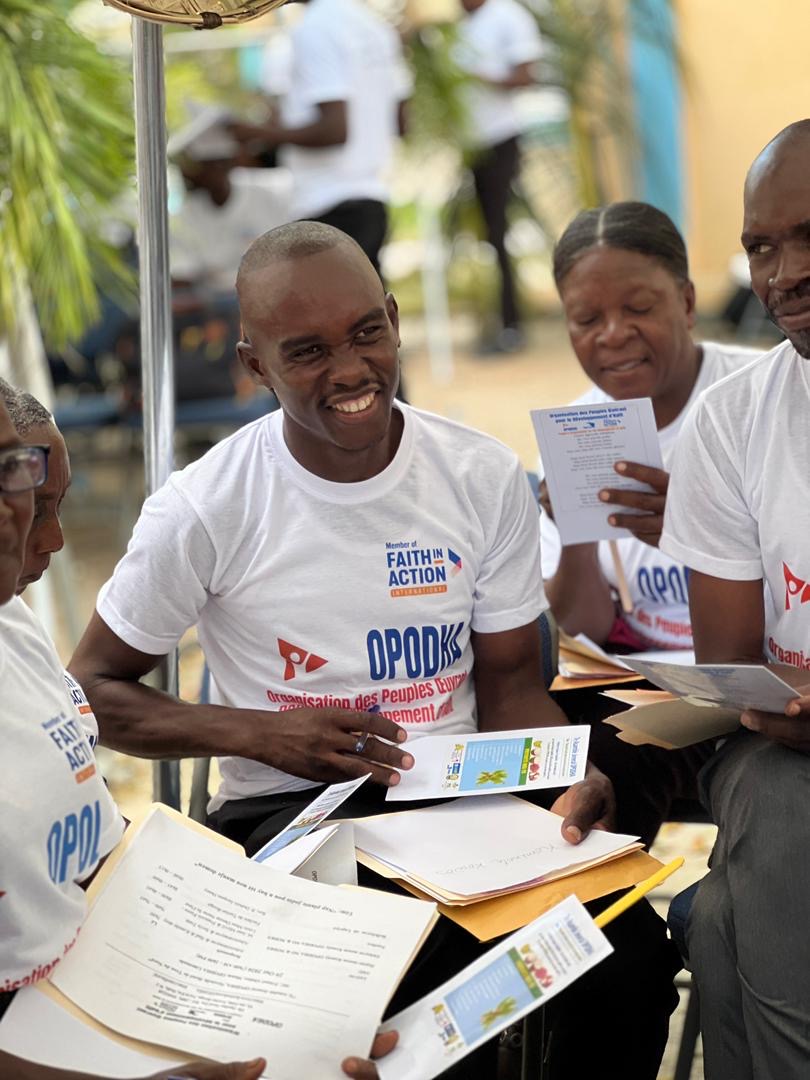
Haiti: Grassroots leaders press for changes in agriculture investments at General Assembly
On Saturday, August 29, more than 400 grassroots leaders from 74 communities, along with local mayors, public officials, and religious leaders, gathered for OPODHA’s Seventh General Assembly in…

Haiti: OPODHA Prepares for Its General Assembly with Agricultural Officials
In Haiti’s North and Northeast Departments, OPODHA leaders are preparing for a general assembly at the end of August that will bring more than 500 members together with…
Make a Difference
Ready to get involved?
We invite you to join a growing movement of people who are putting their money and their voices behind change that is designed and led by those who have the most at-stake. Become par of a global movement to create an equitable world.